Porsche followup

April 22nd, 2008, 11:46 pm PDT by Greg

My earlier post about buying a Porsche has caused much conversation. Some people who I have told about the plan seem to think I’m going out to the dealer next weekend and blowing a lot of money. These people don’t see the inherent joy the plan contains.

You see, I don’t have to actually buy a Porsche for the plan to be wonderful. The plan is great all by itself: with or without a car. The point is that I could buy a Porsche in the not-unforeseeable future. How great is that?

When I told my mother the plan, she laughed appropriately. When I told her about people who interpreted the plan as me imminently heading out to buy, she replied “oh, you’re too cheap for that”. Gotta love her.

I also remembered that I can pinpoint the second I realized I needed a 911. It was when I first watched Top Gear series 10 episode 2. Jeremy Clarkson was reviewing the Audi R8. As they often do, another car was introduced as a counterpoint. Richard Hammond, being a huge 911 fan, offered the 911 Carrera S as a worthy competitor.

The car is introduced in a most dramatic fashion. I have extracted the piece of video that did it for me. Can you watch that and not want a 911? Any car that can be made to slide that far sideways has to be fun to own.

Personally, I’d prefer the Carrera 4S (the four wheel drive version). I’m not actually convinced of my ability to control a vehicle when I have to look out the side window to see where I’m going.

I have however been practicing in Gran Turismo (which doesn’t have Porsches, but still). As I have mentioned here before, I have a Logitech wheel and that gives the whole thing a certain amount of realism.

If I have learned nothing else from Top Gear, it’s that turning off the traction control makes cars more fun (if there’s nothing to hit and you’re not fussy about the condition of the tires). GT4 has traction control turned on for all cars by default, but it can be turned off in the settings screen. With the driving aids off, the powerful rear wheel drive cars seem to mock “you didn’t really think you could use the gas pedal and steering wheel at the same time, did you?”

I can foresee that, while I might not get a Porsche any time soon, Gran Turismo 5 and a PS3 may appear around here much sooner.
Life Plan #3

April 18th, 2008, 12:00 am PDT by Greg

I know that a blog post with the title “Life Plan #3” should be preceded by life plans numbered 1 and 2. The thing is: life plans one and two have some actual realistic possibility of happening, so they aren’t as fun.

SFU’s CIO (Chief Information Officer) just quit. Or he “quit”. The rumours aren’t really clear. In any event, he don’t work here any more.

The CIO is basically an Associate VP Academic by another name. The position is responsible for the campus network infrastructure (including wireless), phones, computer store, email, WebCT, and a bunch of other stuff. Wait… there’s something else in there that’s important… what was it again… oh yeah!

The CIO is responsible for our information. The last guy was responsible for the purchase and subsequent support of PeopleSoft/SIMS/goSFU. You know: the millions-annually albatross around the University’s neck? Go ahead and read the “Peoplesoft in use” section on Wikipedia; I’ll wait. We bought in several years after those very public experiences. I have mentioned the SIMS project here before.

Amanda and a few others have opined that I should apply for the job. They forget two things: (1) I’m not qualified and (2) I don’t want to. I’m not qualified because one would need a hell of a lot more experience with managing both employees (I’d guess the headcount is easily >100) and budget (>$10M) than I have. Also, I’m pretty sure being an undergrad director isn’t sufficient qualification for being an associate VP.

The reasons I don’t want to do it are many. The biggest one is the most obvious: PeopleSoft. The only way to get away from PeopleSoft is to spend some money on another solution. There’s no money to do anything else because PeopleSoft costs so damned much. The person who gets the job is doomed to either spend even more money (in a time of cuts), or be the guy that keeps the shitty solution to the University’s biggest IT problem.

But (because Amanda knows me that well) I have been thinking about it. I’m the kind of guy that looks at the “Careers” section in the newspaper and thinks “CEO of a sporting goods company… yeah, I could do that. Maybe I should apply.”

If I had the job, I’d stop all development on SIMS and skim a quarter of the SIMS budget off for internal development of a replacement. The replacement would have to happen piecemeal, which would require a very clever architecture that could interface with the existing database. If other Universities in BC were willing to team up, it would make sense to join forces since our business practices are mostly similar and we could share most of the code.

Also, there’d be some modernization of the core campus IT infrastructure. Things like virtual machines and AFS would allow real-time replication of essential services across campuses, and leave us much less vulnerable to catastrophic system failures.

In summary: if they don’t hire in the first round and open up applications a second time, I’m going for it.

Vroooom!

April 15th, 2008, 11:36 pm PDT by Greg

I have been watching a lot of Top Gear recently. Top Gear is a British car show: I have been describing it as three middle-aged idiots playing with cars. Their motto is “ambitious, but rubbish”, which pretty fairly describes the challenges they are given.

My favourite challenge, by a wide margin, is when the three of them try to prove that British Leyland made decent cars. That video is about a half hour long, but well worth watching. If don’t howl with laughter during the rough-road test, you just aren’t trying. I love it when one of them almost falls down laughing at another. It happens a lot.

They also spend a lot of time driving outrageously expensive supercars that I could go a lifetime without seeing, let alone driving. Basically, car porn. All of this has made me remember that I actually like driving: I just haven’t ever owned a fun car to drive. Clearly, I need a sports car. Stay with me here…

Now, a nice Ferrari or Lamborghini runs somewhere upwards of $200k, but a Porsche 911 or Lotus Elise is more in the $100k range. A Porsche Cayman is a damn nice car too and lists new for only about $60k.

That’s certainly downright affordable, but I’m not proposing that I buy a brand new Porsche. As with all cars, these things depreciate a lot in the first few years of ownership (which is approximately the time interval between becoming a doctor/lawyer and having a child, forcing you to sell your sports car and get an atrocious SUV). A used 911 that’s in solidly good condition can be had about $50k.

After the first few years, depreciation on such a car should be relative to how much it is driven, not its age: if it’s driven occasionally, well-maintained, and kept in a garage, it should resell for a good price. Fuel economy in one of these cars isn’t actually bad either: they’re so light that the big engine doesn’t have to work terribly hard.

That brings me to the real plan: get a gently-used cheap car (a Yaris, Civic, etc.) and use that for everyday driving. Get a used 911 for occasional fun-driving. Come on… how can you not want that?

Imagine the joy of it: pack an overnight bag, throw it in the 911, and go to the Okanagan (the hard way, through Manning Park) for the weekend. Marvel at the tool beside you that paid only $10k less than you for his ugly, boring SUV.

Of course, we’d have to have a garage to put it in. So, buy a house first. Also, our current car has been making a different noise for the last few weeks. That probably has to be replaced first too. Kat should probably have a job to make it all affordable. Kids are out too, but that was the plan anyway. So, some time in the next decade, this plan may be implementable.

What was most surprising was that Oli and Tina had been watching Top Gear as well, and Oli had the exact same thoughts at the exact same time. He wants the Elise.

Strangely, when I mentioned this plan to Kat, she didn’t really seem to think it was a bad idea. I think it’s a trap.

CMPT 376 Post Summary

April 7th, 2008, 12:39 am PDT by Greg

In week 2 of the semester, I started blogging for CMPT 376. Since then, I have made 37 posts with an average of 284 words per post (not counting this post).

If I had blogged thrice-weekly during that time, there should have been 36 posts. Somehow an extra post slipped in there. The offender seems to be a throwaway post about gaining back an hour of my jetlag.

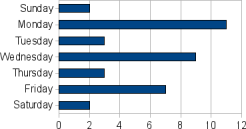
I managed to more-or-less keep the Monday/Wednesday/Friday schedule too, but certainly wasn’t too anal about a little drifting:

Posts by day of week
Posts by day of week: MWF schedule kind of worked.

I also allowed Ted to mock me during lectures. I have clearly earned my full 5% class participation marks and will appeal anything less. As the one who handles mark appeals, I’m pretty sure I will emerge victorious.

That makes my final mark in the course… 5%. Hrm. Clearly I haven’t taken the most efficient route to passing the course. I guess it’s time to do what every student who is about to fail miserably does right before the final: email the instructor and ask if the course is going to be curved. (If you thought the thing after the colon in that sentence was going to be “study”, shame on you.)

Certainly the most surprising thing for me from the course is how really easy the daily writing exercises (a.k.a. blog posts) were. It turns out that I actually think three things a week. Writing close to 300 words about each one didn’t feel like work at all.

I am firmly convinced that writing is like any form of physical activity: the more you do it, the easier it gets. The dailies were a good way to exercise the writing muscle.

So, if I ever end up teaching 376, I will certainly keep the daily writing. I probably wouldn’t do as much free-writing as Ted did, not because I don’t see the value, but doing it in lecture time just isn’t my style. I would probably keep the assignment structure more-or-less the same as well. The thing that would scare me about the course is that, even having seen Ted give most of his lectures, I have no idea what I’d say in 150 minutes of lecture per week.

Oh well, let’s just hope it doesn’t come to that.

Edit: I thought it might be worth sharing the email I sent to Ted as promised above:

Dear Prof Dr Kirkpetrik,

im a student in ur COMP 376 class. i want 2 know if the class is going to be on curved grading or regular? i am worry about my mark, so i want to know what happens.

Maybe there’s a little hyperbole there, but down around the bottom of a first year class, that’s not totally out of range. As you can see, it’s not just ESL issues, but total lack of attention to detail: prof’s name and course number are incorrect. Also note that the form of the question indicates a level of understanding which means an honest answer to the question (e.g. “not curved”) will not help the student in any way.

Facebook Application Update

April 4th, 2008, 1:46 pm PDT by Greg

The “SFU Courses” Facebook application has been up and running for about two semesters now. It ended up working just about like I imagined in my original plan: data comes from the goSFU database, and students can publish an automatically-updated list of their courses on their profile page.

Getting the data took a little political wrangling, but ended up happening without too much trouble. Thanks go out to Richard MacLeod, the Director of Records and Registration, for running interference for me a couple of times when administrators got wind of this and fully misunderstood what it did. The consensus now seems to be that this is a legitimate thing to do with University data, as long as students give permission properly. For the first semester, I was half expecting the President to summon me to his office for a beating at any moment.

The data feed that I eventually got is a little circuitous. Of course, it starts with the live goSFU database. That database is replicated in real time to a backup server. The almost all of the data on the backup server is copied nightly to the “reporting database” that is used for all of the University’s reporting and data analysis stuff. The reporting database is used to feed a legacy database called “AMAINT” that is still used by several older systems around campus. The CS tech staff get a view into AMAINT that runs Gradebook, etc. I have a view to that which is used to update the application’s database.

Miraculously, all of that usually works and I get data that’s updated daily. This is used to update everybody’s profile box every morning with their most current course list.

In previous semesters, I haven’t received upcoming semester data during the registration period. This semester, Nathan from our tech staff got me summer courses almost as soon as registration started, so people could see courses as registration was happening.

There are currently about 1800 Facebook users who have added the application, and 1600 who have also authenticated as SFU users and authorized the relevant data release. The 200 person difference is curious: the application will do absolutely nothing for you if you haven’t agreed to release your SFU data. I have no idea who those 200 people are, or why they have the application.

Overall, I’m pretty pleased with the whole thing, particularly with the number of users. That’s something like of 10% of all SFU students. I can’t think of any other (optional) service the University has for students that has that kind of uptake rate. Maybe residence or orientation?

Anyway, I accomplished my goals: learn the Facebook API, make the University seem a little cooler, give students access to their own data in a useful way.

April Fools Links

April 2nd, 2008, 11:45 am PDT by Greg

Yesterday was April Fools. Most site were pleasantly restrained: I find most Internet April Fools things annoying and commend Joel at Boing Boing Gadgets for his restraint. Still, I had two favourites.

I was Rick Rolled in a most pleasantly non-standard way at Digg. That video is well worth watching: it’s a Muppet Rick Roll (and I’m not Rick Rolling you when I say that).

Then, over at my dearest Boing Boing, I was Numa Rolled. Yay Xeni!

It’s not April Fools related, but my cover song fetish led to me love Leningrad Cowboys and Red Army Choir covering Sweet Home Alabama.

Finally, at Channel 4, they apparently ask celebrities “What’s Your Favorite Curse Word?”

Measuring the Unmeasurable

March 31st, 2008, 11:00 pm PDT by Greg

Today, I’m going to expound on two examples I have come across recently of researchers trying to measure properties that are very difficult to measure, and politically charged.

At SIGCSE, I saw a paper on sex and gender in CS presented, which was thoughtfully titled Cultural Representations of Gender Among U.S. Computer Science Undergraduates: Statistical and Data Mining Results. The results depend on running a bunch of (CS and non-CS) students through the Bem Sex Role Inventory and looking through the results for patterns.

The Bem inventory involves looking at a bunch of adjectives (“analytical”, “warm”, “adaptable”, …), and deciding how much that describes you. Each of the adjectives has a gender that it describes (“masculine” or “feminine”), and you get a score at the end. Of course, there’s a huge cultural bias involved in this score, but gender (as opposed to sex) is a social construct anyway, so off we go.

The results he found were very interesting, but not what I want to get into here. At the end of the author’s presentation, there was much consternation over the use of the Bem Inventory. One woman in the audience in particular had the view that he should have not done the study at all, rather than use this measure that offended her sensibilities.

Of course, the Bem Inventory isn’t perfect: it’s trying to measure an idea that’s moving target, that is not uniform across any significant population, and that is very specific to the U.S. But, it clearly measures something, and not something that there is (apparently) no better way to measure.

I ran across my second example when looking up the authors of the truly excellent book Why Beautiful People Have More Daughters. One of them has recently published an article
on the relationship between IQ and health. [Those with a decent University library can probably find the whole article online: Kanazawa, British Journal of Health Psychology, Volume 11, Number 4, November 2006, pp. 623-642(20).]

The article does confound the terms “general intelligence” and “IQ”. I think it’s pretty hard to argue that the thing we measure and call “IQ” is the platonic ideal measure of “intelligence”. That being said, it’s clear that IQ is a measure of something. It turns out that the “something” that IQ measures is strongly correlated with life expectancy (stronger than income inequality or economic development).

As a result, the author was accused of promoting eugenics. Now, maybe I didn’t read the paper carefully enough, but I didn’t see the “kill the dumb ones” part. The author didn’t even actually measure anything himself: the whole paper is a meta-analysis of other studies of IQ and health. All he did was grind out some stats.

Anyway, both of these studies have the same underlying issue: they rely on the measurement of something that isn’t possible to measure very well. In addition, the thing being “measured” is something that has a bunch of emotion attached to it. I don’t think the solution here it to just not study this stuff. Let’s just all recognize that correlation with the thing we’re trying to measure will do in a pinch.

Cheating Cheaters

March 28th, 2008, 11:38 am PDT by Greg

I was on another University Board of Student Discipline case yesterday. (I was on the Board, not bringing a case forward.) I mentioned a UBSD case previously where I was on the board, and the case resulted in a big and complicated penalty.

The penalty in this case (that we recommended to the President) was a new one for me, simpler, and fairly rare for SFU: permanent expulsion from the University.

The case ended up being even more severe than I thought when I got there. The core issue was impersonation during a midterm and final exam. The student (the real student) had a previous academic dishonesty case, and there were some other aggravating factors after the case began. Altogether, it ended up as a really serious case.

Something I did learn is that impersonating someone in a final exam, or benefiting from it is a criminal code violation:

Every one who falsely, with intent to gain advantage for himself or some other person, personates a candidate at a competitive or qualifying examination held under the authority of law or in connection with a university, college or school or who knowingly avails himself of the results of such personation is guilty of an offence punishable on summary conviction.

The University likely won’t recommend charges in this case, but it’s good to know it’s an option. Note that it’s the criminal code (police, handcuffs, and jail), not the civil code (fines and lawsuits).

CMPT 470

March 25th, 2008, 7:21 pm PDT by Greg

As many of you know, I’m teaching CMPT 470 downtown in the summer. Since I’m on sabbatical from fall 2008 to summer 2009, if you want to take CMPT 470 from me any time soon, this is your chance.

The School had already committed to offering 470 downtown in the summer semester. Rather than offer a tiny section downtown and a regular section in Burnaby, we decided to do the course downtown only. Lectures are 3 hours on Wednesday nights.

That will kinda leave me with 6 day weekends. Things don’t really work that way, but it will mean Kat and I can do a little not-too-far travelling during the summer.

Democratic Primary: please die

March 24th, 2008, 11:44 pm PDT by Greg

I have been following the US Democratic Primary. I do this partially because I’m affected by the outcome, as the winner will have a non-trivial effect on my life as a Canadian, and partially because it’s more-or-less as interesting as American Idol as reality TV goes.

Frankly, I’m starting to get a little tired of it. It’s starting to take on the character of a crappy romantic comedy where you know it’s going to end with the girl getting the guy, but you still have to sit through 45 minutes of charming misunderstandings before you can go home. Let me explain…

Fact #1: Obama is going to win the pledged delegate count: Slate does a good job of explaining why. Clinton has only won one state with the 64% she would have to get in all of the remaining contests to come out on top. Even wackiness with Florida and Michigan wouldn’t get Clinton into the lead.

Fact #2: The superdelegates won’t overturn the pledged delegates. Many prominent democrats are against it, it would cause a crazy civil war in the party, and my guess is that it would cost them the general election.

So, Obama’s going to win the Democratic nomination. Congratulations. Why do I still have to read about the whole thing in every other Digg headline? I know the media has a vested interest in keeping things going, but come on.

Given that the protracted contest is supposed to be bad for eventual nominee, why aren’t the superdelegates putting me out of my misery? All they have to do is give a quick speech about how they’re going to honour the will of the electorate and support Obama. They get to be on the winning side and “save” the party. Somebody with a few stones could also suggest that it was time for Clinton to call it a race too.

Bill Richardson just did exactly that and it will probably get him a cabinet seat. If a few high profile superdelegates came out on Obama’s side, it would pretty much seal the deal. Any idea why others aren’t following suit?

« Previous Entries   Next Entries »